
Overview
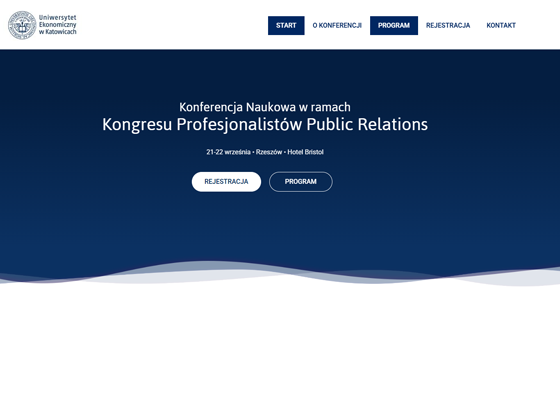
This project involved designing and developing a dedicated functional website for a national scientific conference held as part of the Congress of Public Relations Professionals, one of the longest-standing PR industry events in Poland. The conference brings together researchers, academics, communication experts and marketing practitioners from leading Polish universities and institutions.
The website’s primary purpose was not traditional branding or marketing. It served as a functional tool — a centralized platform for program details, registration, abstract submissions, publication guidelines, important dates and communication with participants.
Our goal was to build a fast, intuitive and well-structured interface that simplifies the entire conference workflow.
The challenge
Unlike typical marketing-focused websites, conference platforms must handle very specific functional demands. The previous conference pages were built in a fragmented way, lacked structure and required a complete overhaul.
Key challenges included:
• no unified content architecture for academic conferences
• no automated or structured registration flow
• difficulty communicating complex information such as publication rules, scientific committees, important dates and abstracts
• weak mobile usability, especially for last-minute participants looking up details
• outdated design not aligned with the prestige of the universities involved
• multiple organizers → need for clear, neutral, academic-friendly presentation
• event taking place both on-site and online (hybrid format)
• content heavy in text → need for readability and hierarchy
The website needed to support hundreds of participants across research institutions such as the University of Economics in Katowice, University of Warsaw, University of Economics in Poznań and the Poznań Society of Friends of Sciences.
Our solution
We designed and delivered a clean, highly structured scientific conference platform, optimized for readability, registration and communication.
1. Academic-grade UX & UI design
• neutral, institutional visual style suitable for multiple university organizers
• focus on clarity and information hierarchy
• structured layout for conference theme, description, program, committees and partners
• consistent formatting for long academic text sections
• clean typographic system for multilingual content
• restrained visuals to maintain credibility and neutrality
2. Functional conference architecture
We implemented all sections required for a fully operational academic event:
• program overview + downloadable schedule
• online registration form with required fields
• abstract submission guidance
• list of scientific board members
• publication rules and journal information
• detailed timeline with milestones and deadlines
• contact directory for organizational, financial and editorial questions
• photo gallery from previous editions
• structured “About the Conference” section explaining the scientific background
Everything was optimized for quick scanning — crucial during a conference event where users are looking for information fast.
3. Technical performance and accessibility
• fully custom WordPress theme (no builders, no bloat)
• high-speed performance for mobile and low-bandwidth users
• semantic structure to improve searchability
• accessibility-friendly layout and contrast levels
• fast-loading images, compressed backgrounds and responsive media
4. SEO and discoverability
Even though the site was functional rather than promotional, we ensured strong event visibility:
• SEO-friendly structure for conference keywords
• clear metadata and optimized page titles
• clean URL structure for each section
• improved discoverability for participants searching the event online
• indexing improvements beneficial for future editions
Outcome
The final website delivered a reliable, clear and efficient conference platform used by universities, researchers and PR professionals from across Poland.
Results
• streamlined participant registration process
• higher clarity of information, reducing organizer workload
• improved readability of academic content
• professional appearance aligned with the credibility of partner institutions
• smoother communication across multiple departments
• mobile-first interface for participants joining the event on-site
The site successfully supported the hybrid conference on 21–22 September, making important event information easy to access before, during and after the event.
Impact
For academic and industry events, clarity and functionality are the highest priorities. The new website became a practical tool that simplified coordination between organizers, presenters and participants. With better structure, improved accessibility and professional presentation, the conference achieved higher engagement and smoother execution.